by
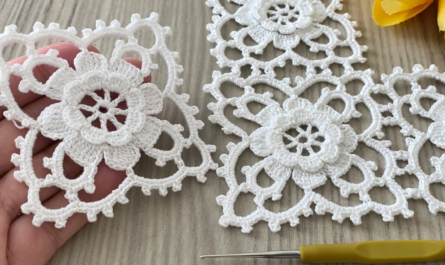
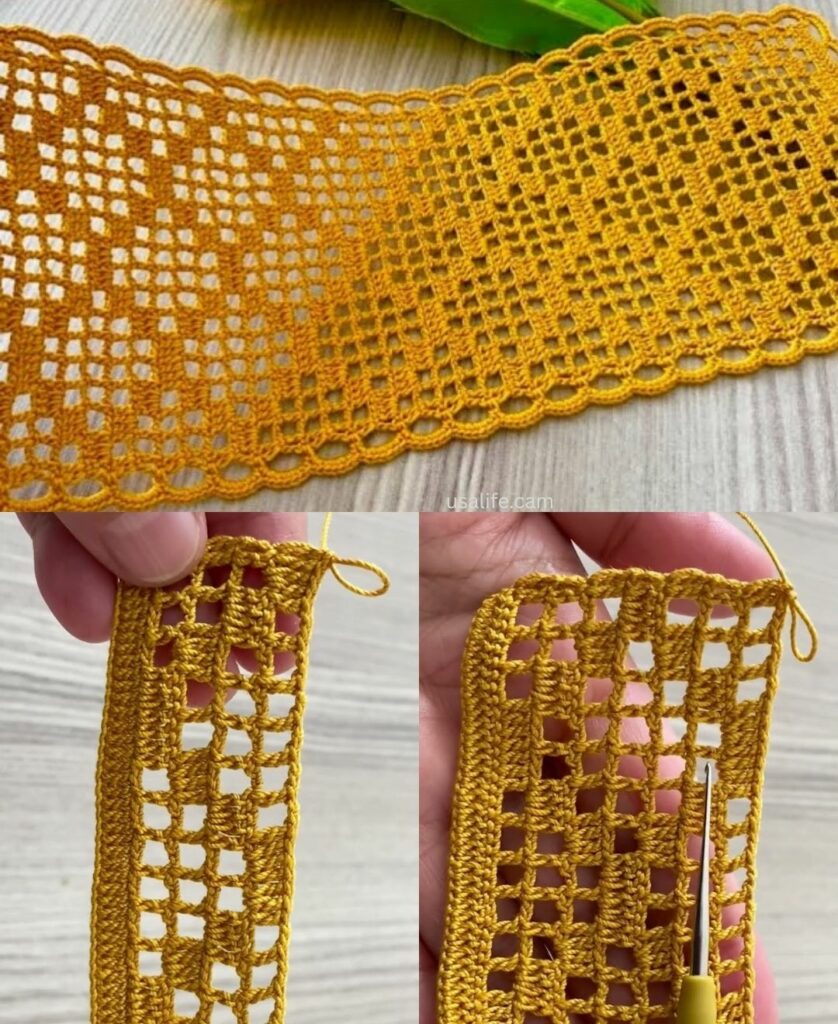
by The Cage Tile Motif is a sophisticated, architectural design that mimics the look of ornamental ironwork or vintage window tiles. It is defined by “heavy” structural bars (the cage) that surround a delicate, airy center (the tile).
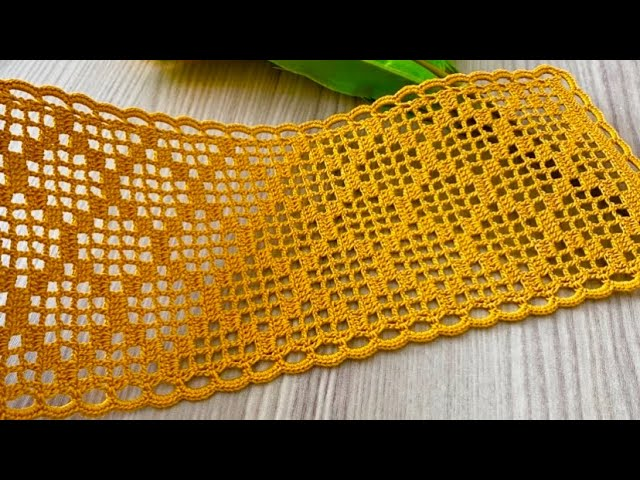
This pattern is a favorite for high-fashion blouses because the “cage” lines provide structure, while the open “tiles” offer breathability. When used for a table runner, it creates a stunning geometric shadow on the wood beneath it.
🧶 Material & Project Guide
| Project | Suggested Yarn | Hook Size |
| Architectural Blouse | Linen or Pima Cotton (Fine/Weight 2) | 2.5 mm – 3.25 mm |
| Modern Table Runner | Mercerized Cotton (DK/Weight 3) | 3.5 mm – 4.0 mm |
| Geometric Throw | Cotton/Acrylic Blend (Worsted/Weight 4) | 5.0 mm – 5.5 mm |
Stitch Key (US Terms)
- ch: Chain
- sc: Single Crochet
- dc: Double Crochet
- tr: Treble Crochet (Yarn over twice)
- V-Stitch: (dc, ch 2, dc) in the same stitch.
- Cage Bar: A long chain sequence that skips several stitches to create a “bar” look.
🛠 Step-by-Step Tutorial: The Cage Tile
Round 1: The Inner Tile Core
- Start: Make a Magic Ring.
- Stitches: ch 3 (counts as dc). Work 11 dc into the ring.
- Join: sl st to the top of the ch 3.

Result: A solid center disk of 12 dc.
Round 2: The Lattice Windows
- ch 4 (counts as dc + ch 1).
- Repeat: [dc in the next stitch, ch 1] in every stitch around.
- Join: sl st to the 3rd chain of the starting ch 4.
Result: 12 “windows” radiating from the center.
Round 3: Creating the “Cage” Bars
This round uses long chains to create the structural “bars” that define the cage look.
- ch 1, sc in the same stitch.
- The Bar: ch 5. Skip 2 dc posts from the previous round. sc into the 3rd dc post.
- Repeat: [ch 5, skip 2 posts, sc in the next post] 3 more times.
- Join: sl st to the first sc.
Result: You now have 4 large cage loops around your circular tile. It will look a bit “floppy” until the next round.
Round 4: Squaring the Cage
We will fill the loops with stitches of varying heights to create a perfect $90^\circ$ tile.
- Move Hook: sl st into the first ch-5 cage loop.
- The Corner: ch 4 (counts as tr). In the same loop, work (2 tr, ch 3, 3 tr).
- The Side: ch 1. In the same loop (after the corner), work 3 dc.
- Transition: ch 1.
- Repeat: In the next ch-5 loop, work: [Corner (3 tr, ch 3, 3 tr), ch 1, 3 dc, ch 1].
- Join: sl st to the top of the ch 4.
Round 5: The Outer Frame
- sc in every dc and tr stitch around.
- In Corners: Work (2 sc, ch 2, 2 sc) in the ch-3 space.
- Finish: Fasten off and weave in ends.

📐 Assembly for Professional Models
1. The Blouse Construction
Because the “Cage Tile” is very geometric, it works best in a straight-line assembly.
- Design Tip: Join the tiles using the “Flat Slip Stitch Join” on the right side. This adds an extra “bar” of texture between the tiles, emphasizing the caged look.
- Math: If your tile is $12\text{ cm} \times 12\text{ cm}$, a standard $48\text{ cm}$ wide blouse panel will require exactly 4 tiles across.
2. The Magnificent Table Runner
- Design Tip: Use a high-contrast color for the final Round 5 (the Frame). For example, a cream center with a charcoal frame.
- Blocking: This pattern requires blocking. Because the Round 3 chains are long, they may pull unevenly. Pin the corners firmly to a board to “lock” the cage bars into straight lines.
💡 Insight: Why “Cage” Tiles?
The mathematical beauty of this motif lies in the Symmetry of the Voids. In crochet, what you don’t stitch is often as important as what you do. The ch-5 loops in this pattern create “negative space” that makes the structural stitches look heavier and more intentional.
Pro-Tip: If you want a more “heavy metal” cage look, replace the dc in Round 4 with hdc (Half-Double Crochet). This makes the sides shorter and the corners (Treble Crochet) look even sharper and more dramatic.
Would you like me to show you how to calculate the total yardage needed for a full-size blanket using these Cage Tiles?