 by
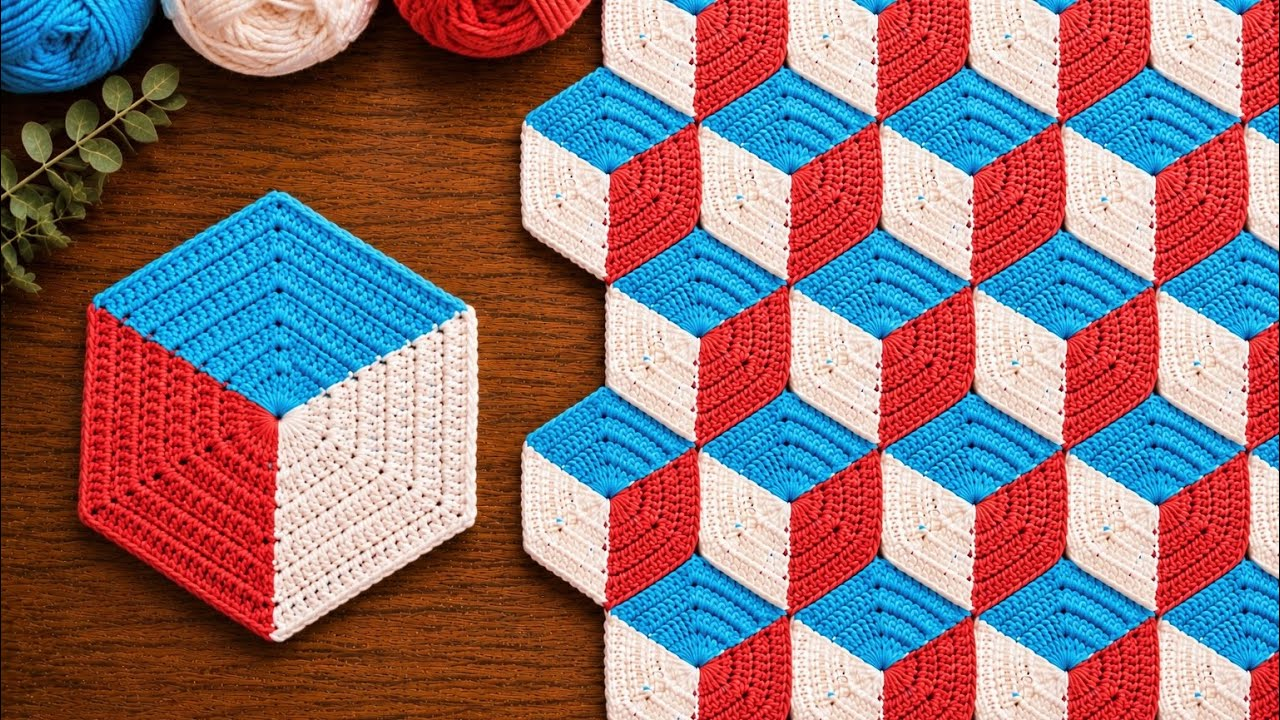
by To achieve a “Catching” Geometric Look—the kind that makes people stop and look twice—you must shift your focus from the individual stitch to the negative space and the color transition.
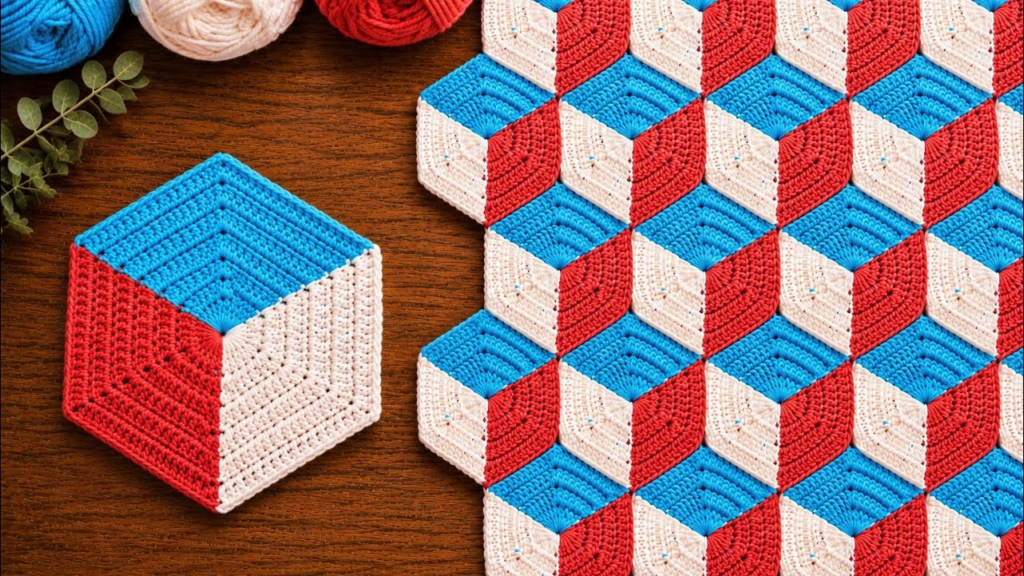
A hexagon, by nature, is an architectural shape. When arranged correctly, it creates a “honeycomb” or “tessellated” effect that is inherently more sophisticated than the square. Here is how to construct a high-impact, geometric hexagon design.
🧶 The Architectural Toolkit
For geometry, stitch definition is your only priority. You want a yarn that is “smooth,” not “fuzzy.”
| Material | Recommendation | Why? |
| Yarn | 100% Mercerized Cotton (DK weight) | It doesn’t stretch or fuzz, keeping your geometric lines “razor-sharp.” |
| Hook | 3.5 mm (E/4) | A slightly smaller hook ensures the fabric is dense, not holey. |
| Colors | High-Contrast Triads | Use a dark, a medium, and a light color to create a “3D” depth effect. |
🛠 The “Catching” Design Formula
To get that stunning, professional look, follow the “1-2-3” rule of geometric design:
1. The Core (The Anchor)
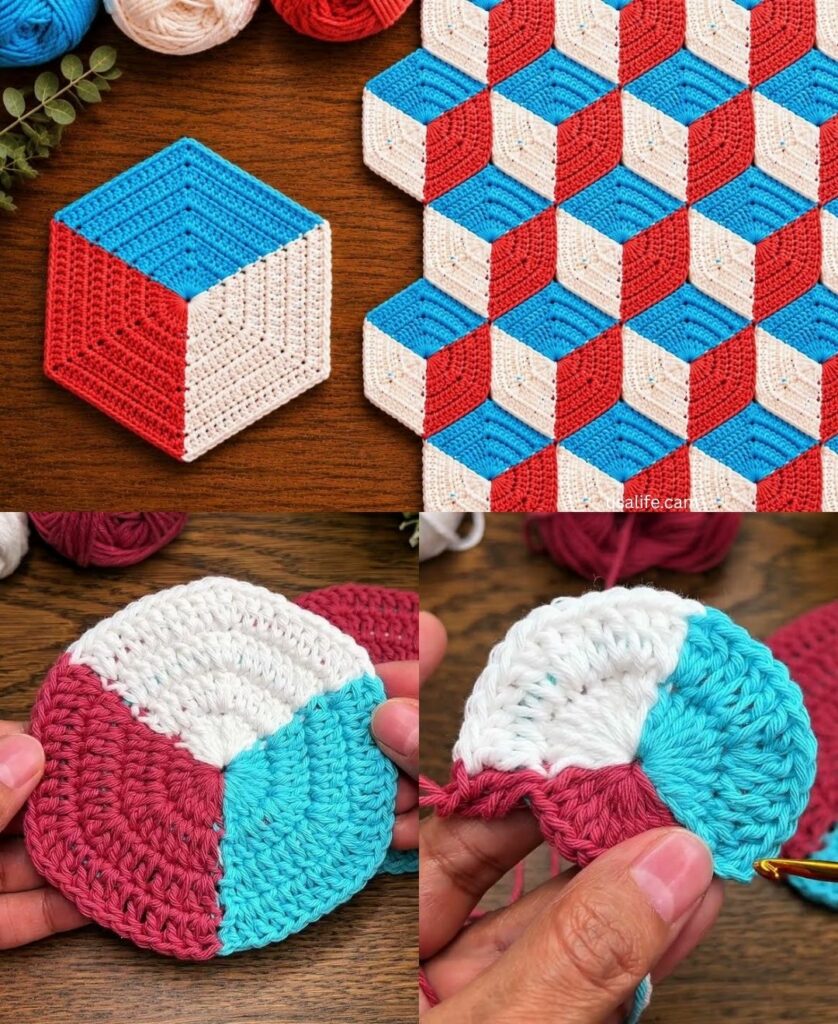
Start with a Magic Ring. Work 6 clusters of 2 dc into the ring. This creates a “6-petaled” flower base. Using a dark color here draws the eye to the center of the motif.

2. The Expansion (The Geometry)
Work your second and third rounds by increasing only at the 6 points (the corners).
- The “Catching” Trick: Work your dc stitches in the Back Loop Only (BLO). This creates a small, raised ridge on every round. When the motifs are joined, these ridges act like “structural beams,” catching the light and creating a beautiful 3D texture across the entire project.
3. The Frame (The Sharp Edge)
The final round is where you turn the hexagon into a “tile.” Work this round in a contrasting neutral (like white, cream, or light grey). By using a slightly taller stitch (a treble crochet) in the corners and a shorter stitch (a single crochet) in the center of the sides, you ensure your hexagon has a perfectly flat, non-wavy edge.
📐 The “Tessellation” Math
The “Catching” look comes from the layout. Because hexagons have 6 sides, they don’t stack in a grid; they interlock.
- The “Half-Hex” Fill: When making a straight-edged runner or blanket, you will have gaps at the edges. You must crochet half-hexagons (split the motif down the center) to create a perfectly straight border.
- Total Motifs Formula ($T$): If $N$ is your number of hexagons per row, you are looking for a staggered layout:$$T = (\text{Rows} \times N) – \text{adjustment for staggered edges}$$
✨ 3 Secrets for a Professional Finish
1. The “Invisible” Join
Do not use a standard whip-stitch (which creates a bulky ridge). Use a Slip Stitch Join through the Back Loops Only. It creates a clean, flat “seam” that looks like a hand-stitched line in a piece of high-end clothing.

2. The Steam-Blocking Ritual
Geometric motifs must be flat. If they are even slightly “wobbly,” the entire geometric pattern will look “homemade.”
- Step: Pin every corner of every hexagon to a foam board.
- Step: Use a handheld steamer (do not touch the iron to the yarn!).
- Step: Let them dry for 24 hours. This “kills” the memory of the yarn and ensures they stay perfectly flat forever.

3. Color Blocking (The Optical Illusion)
To make your design truly “catch” the eye, try the Gradient Method:
- Make all your hexagon centers one color.
- Change the middle rounds of the hexagons so they slowly transition from light to dark as you move across the runner or blouse.
- This creates an “ombre” effect that makes a simple geometric pattern look like a professional art installation.
💡 A Designer’s Candor
Geometric crochet is a game of tension. If your left hand is tighter on the last 5 hexagons than it was on the first 5, the project will look “off.” Pro-tip: Crochet in “batch sessions” of 5 motifs at a time, then take a break. This resets your hand tension and keeps your hexagons identical in size.
Would you like me to help you map out a “Gradient Color Chart” for a 50-motif table runner?